The Lost Rhythm
Your answer
Your gut has lost its timing signals, so it stalls, rushes, or swings between the two.
We call this the Lost Rhythm.
What your answers told us
What’s actually happening
Your bowels aren’t random. They run on a clock, and that clock depends on signals:
Your body clock. Your colon is quietest overnight and becomes much more active in the hour after you wake.
Your first meal. Eating triggers the strongest “go” signal of the day.
The gaps between meals. A cleanup wave sweeps through your gut, but only when you’re not eating.
Your nervous system. Stress can slow things down or speed them up.
Your gut bacteria. About 90% of your body’s serotonin is made in your gut, and your bacteria help control how much. Serotonin helps drive movement.
Your habits. Ignoring the urge to go dulls the signal over time.
Irregular sleep, a skipped breakfast, coffee as your only morning trigger, long days sitting, travel and stress all blur these signals.
Which way does your rhythm break? Your plan has a track for each:
Stalls
Feels like:
Slow, stuck, hard, incomplete
Common drivers:
Low movement, stress shutting things down, holding off the urge, methane-producing gut microbes
Rushes
Feels like:
Loose, urgent, unpredictable
Common drivers:
Stress surges, coffee on an empty stomach, excess bile reaching the colon, microbial imbalance
Swings
Feels like:
Both, at different times
Common drivers:
Mostly timing, the clearest sign of a lost rhythm. Sometimes loose stool leaks around a backed-up colon, so it looks like both.
Why what you’ve tried hasn’t worked
If your gut stalls, more fiber can add bulk to a system that isn’t moving it, which often means more bloating. Laxatives override the signal instead of retraining it. If it rushes, anti-diarrhea medicines mute the output, and skipping meals or cutting foods removes more of the cues your gut needs.
Both approaches act on the stool, not the timing. Think of an orchestra without a conductor: turning the volume up or down doesn’t fix the tempo.
Your first priority
Retrain the clock: when you wake, when you eat, and when you move.
Your 5-day plan
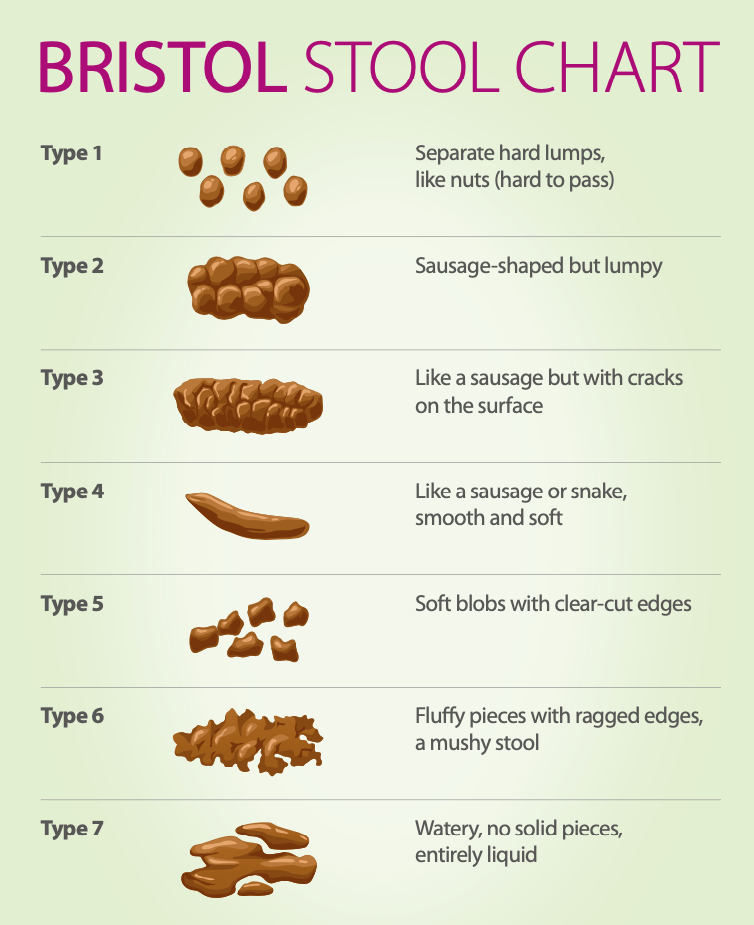
Running all week: your bathroom log. Each time you go, note the time and the type of stool, using the Bristol Stool Chart bellow (type 1 is hard lumps, type 7 is watery, types 3 and 4 are the goal).
Day 1: Anchor your wake time. Wake at the same time every day, weekends included. Get a few minutes of morning light outside, and have a warm drink before your coffee.
Day 2: Use the morning reflex. Eat breakfast within an hour of waking. Afterwards, give yourself up to ten unhurried minutes in the bathroom, with no straining and no phone.
Day 3: Eat on a schedule. Eat your meals at roughly the same times, and stop grazing between them.
Day 4: Your track.
Stalls: use a small footstool under your feet on the toilet, and never put off the urge when it comes.
Rushes: have coffee after food, never on an empty stomach. Keep your first meal calm, and spread your fluids through the day.
Swings: do both.
Day 5: Move after meals, then review. Take a 10 to 15 minute walk after your main meals. Then look back over your bathroom log and ask: are my visits starting to land at similar times, and are more of them type 3 or 4?
What can wait
You don’t need to change your fiber, add magnesium, or start any new supplement yet. Which type of fiber, which form of magnesium and how much depends on which way your rhythm breaks, and on the cause behind it. Functional testing can wait too.
Working with the foundations in your 5-day plan is the right way to start improving your digestion. This is where I start with my private clients, and most are surprised how much these simple changes do.
What to watch
See your doctor first if you have a new bowel change that hasn’t gone away, especially if you’re over 45; blood in your stool or black stools; unexplained weight loss or anemia; symptoms that wake you at night; severe abdominal pain with vomiting or being unable to pass gas; or a family history of bowel cancer or inflammatory bowel disease.
Rushes: if loose stools have been your main pattern for more than four weeks, ask your doctor to check for causes such as coeliac disease, inflammatory bowel disease or infection. The habits in your plan are safe to try in the meantime.
Stalls: don’t stop prescribed or regular laxatives suddenly. Talk to your doctor about any changes.
Your next step
The direction your rhythm breaks tells us where to look. Five days can help reset the timing. They can’t tell you why it was lost in the first place: stress physiology, your microbiome, thyroid or hormonal factors, or something else.
This is what we do inside Gut Off Your Mind, and we work on it in the right order, so your gut keeps its own rhythm instead of needing constant management.
This is a starting point, not a diagnosis. If you have unexplained weight loss, blood in your stool, or symptoms that wake you at night, see your doctor first.